Online reputation management keeps an Australian business visible, accurate and credible across customer reviews, branded search results, business listings, social mentions and owned website content. The work starts with monitoring, then moves into review response, content correction, platform reporting, website maintenance and monthly evidence. A practical ORM workflow separates routine trust-building from active issue response, so the business knows what to check, who acts and which records prove the issue was handled.
What Is Online Reputation Management?
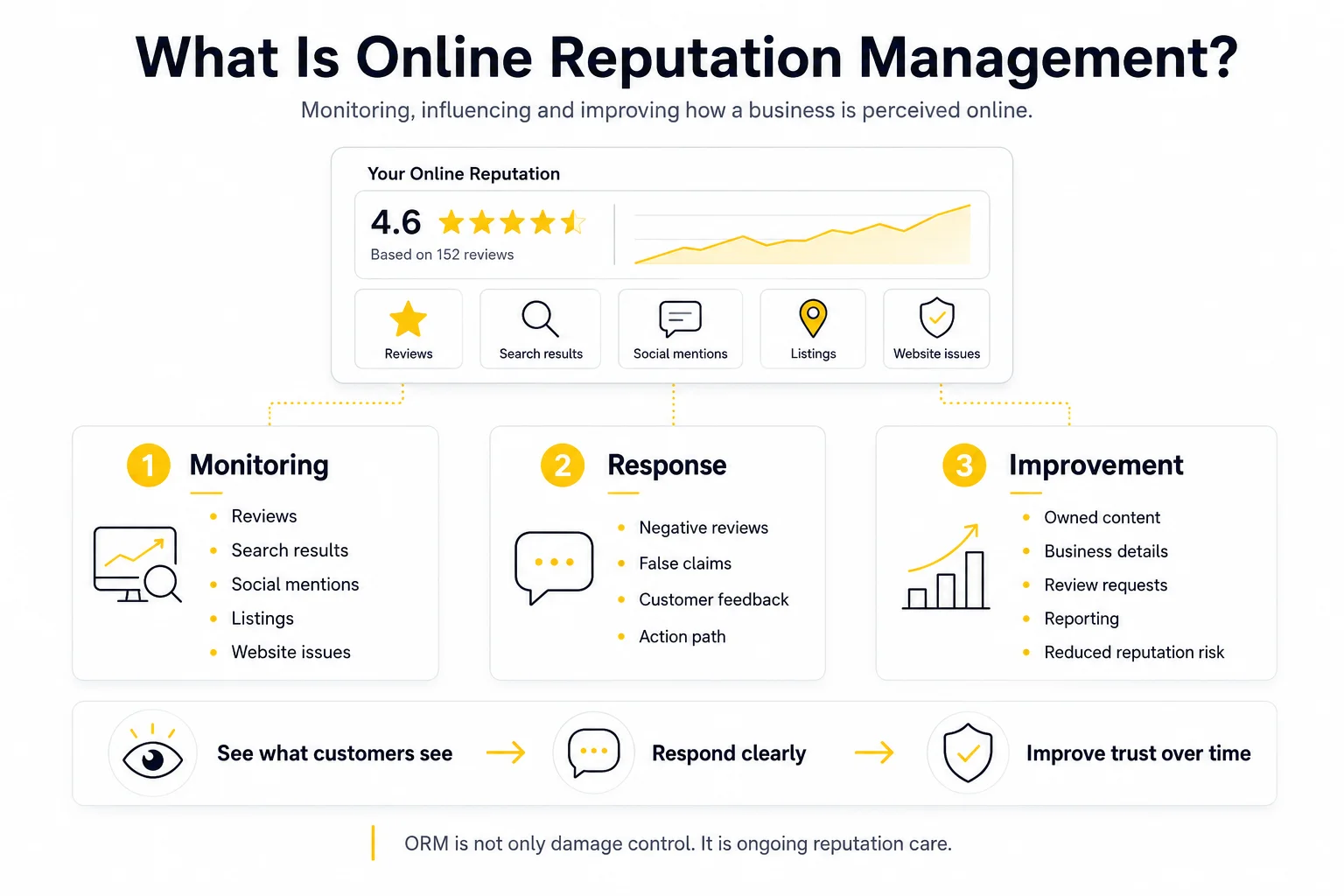
Online reputation management is the process of monitoring, influencing and improving how a business is perceived online across reviews, search results, third-party platforms, social mentions and website content.
The practical scope includes review management, branded search checks, listing accuracy, complaint response, content updates, website trust signals and reporting. ORM is not only damage control. It is recurring reputation care that records what customers see, what they say and what the business changes in response.
- Monitoring: reviews, search results, mentions, listings and website issues stay visible.
- Response: negative reviews, false claims and customer feedback receive a documented action path.
- Improvement: owned content, business details, review requests and reporting reduce repeat reputation risk.
Why Does Online Reputation Management Matter For Australian Businesses?
Online reputation management matters for Australian businesses because customers often compare reviews, Google results, business profiles and website trust signals before contacting a provider or buying online.
A local service business depends on Google Business Profile, review sites, directory accuracy, phone details and recent customer feedback. An ecommerce store depends on product reviews, delivery feedback, return clarity and branded search results. Professional services rely on reputation signals that show accuracy, privacy, response quality and proof of expertise.
ORM also affects hiring and referral confidence. A business with unanswered complaints, outdated listings, broken enquiry forms or suspicious review patterns creates avoidable doubt before the first conversation starts.
What Does Online Reputation Management Include?
Online reputation management includes monitoring, review response, branded search checks, listing management, content correction, platform reporting and reputation reporting.
- Review management: track Google reviews, industry reviews and customer feedback themes.
- Search-result management: check branded search pages for reviews, outdated pages, competitor ads, forums and news items.
- Business listing checks: keep name, address, phone, service area, hours and category details consistent.
- Social and forum mentions: monitor public comments that affect customer trust or create escalation risk.
- Website content: keep service pages, testimonials, case studies, contact details and complaint paths accurate.
- Customer response: answer negative reviews with facts, privacy control and a clear next step.
- Reporting: record rating trends, response times, unresolved issues, actions completed and next priorities.
Which Online Reputation Signals Does A Business Monitor?
A business monitors reviews, branded search results, Google Business Profile changes, social mentions, forum comments, website faults, contact-form issues and sentiment trends.
- Reviews and ratings: star movement, review volume, new complaints and repeated service themes.
- Branded search: first-page results, sitelinks, competitor ads, outdated pages and negative discussion results.
- Business profiles: categories, trading hours, services, photos, questions and owner responses.
- Social and forums: public comments, repeated questions, unresolved complaints and misinformation.
- Website trust signals: broken forms, SSL warnings, stale content, slow pages and missing contact details.
- Sentiment patterns: recurring praise, recurring complaints and changes after service or policy updates.
Signal priority depends on industry risk, acquisition channel and customer behaviour. A clinic, trade business, restaurant, ecommerce store and consulting firm all monitor different review surfaces first.
Which Australian Review And Search Platforms Matter Most?
The most important platforms are the places customers use to discover, compare and complain about the business, starting with Google Search and Google Business Profile.
- Google Search and Google Business Profile: branded search, local discovery, reviews, photos, questions and map visibility.
- Industry review platforms: healthcare, trades, hospitality, professional services and software categories often have specialist directories.
- ProductReview.com.au and Trustpilot: relevant for products, ecommerce, subscription services and larger consumer brands.
- Social platforms: Facebook, Instagram, LinkedIn, TikTok and YouTube matter when customers comment publicly or research the brand there.
- Directories and forums: local directories, Reddit, Whirlpool, Quora and industry forums matter when branded discussions rank in search.
How Does A Business Respond To Negative Reviews?
A business responds to negative reviews by verifying the issue, answering publicly with facts, protecting customer privacy, moving detailed resolution offline and recording the fix.
- Pause and verify the review against the booking, order, invoice, support ticket or staff record.
- Acknowledge the customer without disclosing private details or arguing in public.
- State the next step: contact channel, case reference, store manager, support inbox or complaint process.
- Move sensitive details offline and keep the public reply brief.
- Fix the underlying issue where the complaint is valid, then record the internal action.
- Report reviews that breach platform policy, such as impersonation, conflicts of interest or spam.
- Review repeated themes monthly so the same complaint does not become a pattern.
A useful response pattern is: thank the reviewer, name the issue in neutral terms, state the contact path and close with the action owner. The reply serves future readers as much as the original reviewer.
Can Negative Online Content Be Removed?
NO, negative online content cannot always be removed because removal depends on the source, platform rules, factual accuracy, policy breach evidence, legal grounds or publisher cooperation. ORM also uses correction, public response, platform reporting, content updates and stronger owned assets when direct removal is unavailable.
What Is The Difference Between ORM And SEO?
ORM manages trust and perception across owned and third-party surfaces, while SEO improves organic discoverability, crawlability and traffic from search engines.
| Area | ORM | SEO |
|---|---|---|
| Main focus | Brand perception, reviews, complaints and trust signals. | Search visibility, rankings, crawl access and traffic. |
| Primary surfaces | Google reviews, review sites, forums, social platforms, listings and branded SERPs. | Website pages, technical SEO, content, links and structured data. |
| Core actions | Monitor, respond, correct, report, escalate and build authentic review signals. | Audit, optimise, publish, fix technical issues and improve content coverage. |
| Success indicators | Fewer unresolved complaints, better response times, cleaner branded results and clearer trust evidence. | Improved crawl health, stronger landing pages, more qualified organic traffic and conversion tracking. |
The two areas overlap in branded search, website content, local listings, review signals and technical site quality.
How Does Online Reputation Management Work?
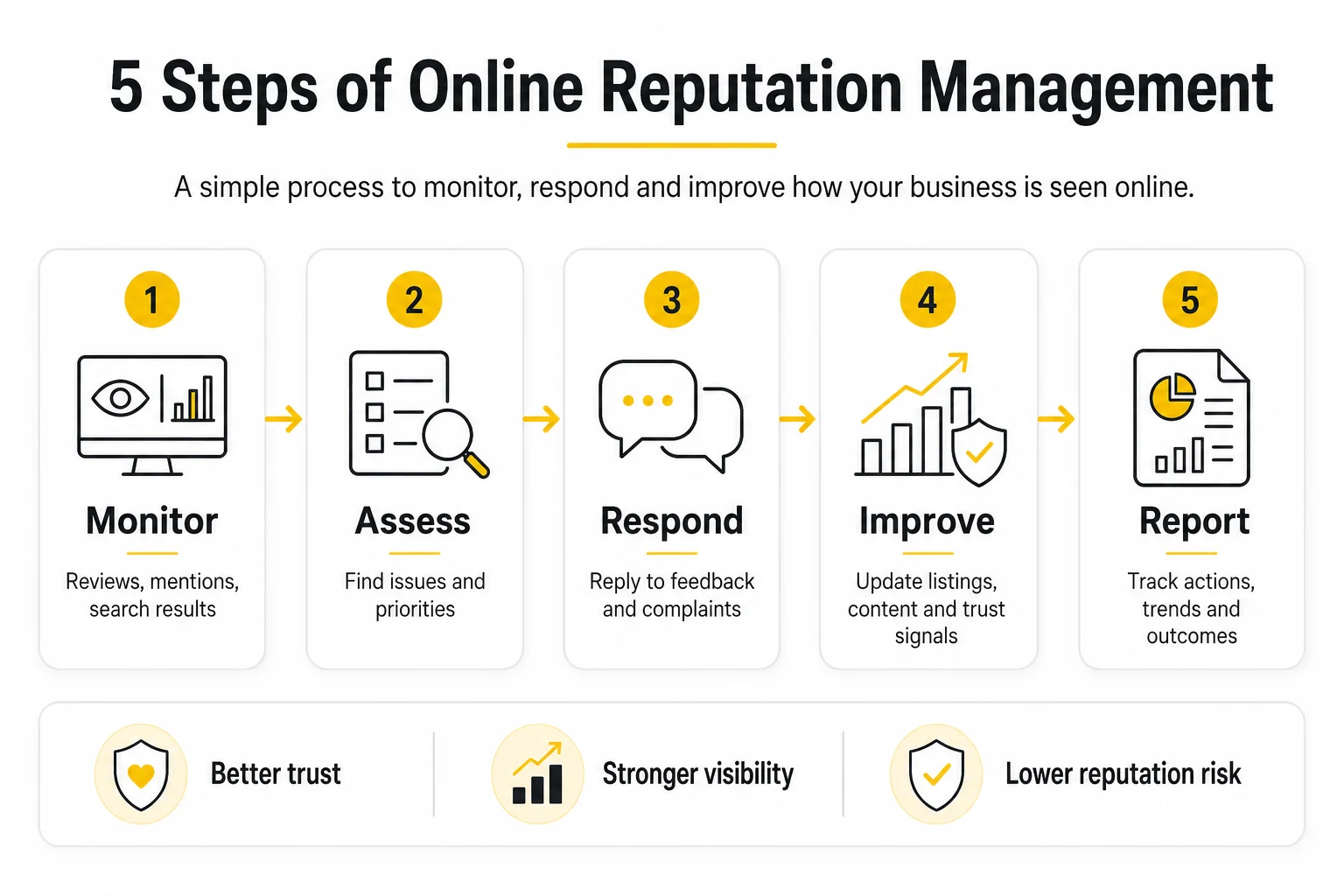
Online reputation management works as a recurring workflow that audits the current footprint, monitors priority channels, responds to issues, improves owned assets and reports actions.
- Audit the current footprint: search the brand name, review the Google Business Profile, list review platforms, check directory details and record visible risks.
- Set monitoring channels: track Google reviews, branded search, social mentions, forums, website forms, profile edits and customer feedback themes.
- Classify signals: separate normal feedback, urgent complaints, false information, policy breaches, legal risk and website faults.
- Respond and escalate: reply to reviews, contact affected customers, flag policy-breaching content and assign specialist help where risk is high.
- Improve owned content: update service pages, contact details, testimonials, case studies, FAQs, complaint paths and website trust signals.
- Build review momentum ethically: ask eligible customers consistently, avoid review gating, avoid fake reviews and keep response records.
- Report and repeat: measure ratings, response time, unresolved issues, website incidents, completed actions and next priorities each month.
Which Tools Help With Online Reputation Management?
ORM tools support monitoring, response, review collection, branded search tracking, customer feedback and reporting, but the tool does not replace the response owner.
| Tool category | What it tracks | Action it supports |
|---|---|---|
| Review management platform | Reviews, ratings, response status and request workflows. | Reply faster and identify repeated service issues. |
| Social listening tool | Brand mentions, sentiment, comments and public discussions. | Detect complaints outside review platforms. |
| Google Alerts and search checks | New indexed mentions, news, forum pages and branded search changes. | Find search-result issues early. |
| SEO and SERP tracker | Ranked branded pages, competitor ads, sitelinks and snippets. | Separate SEO work from reputation risk. |
| Survey and feedback tool | Customer satisfaction, service comments and private feedback. | Fix issues before they become public reviews. |
| Reporting dashboard | Review volume, response time, sentiment themes and completed actions. | Turn reputation data into monthly priorities. |
How Much Does Online Reputation Management Cost?
ORM cost depends on service scope, urgency, brand risk, number of locations, review volume, monitoring requirements, content work and crisis involvement. A simple monitoring and reporting setup costs less than multi-location review response, content repair, legal escalation or active crisis work. Use a quote path when no verified service price exists.
How Does Website Maintenance Support Online Reputation Management?
Website maintenance supports ORM by keeping the business website accurate, secure, available, fast and ready to receive customer enquiries when people check the brand after reading reviews or search results.
- Availability: uptime monitoring catches outages that damage branded search trust.
- Security: malware scans, SSL checks and user access reviews reduce visible risk signals.
- Accuracy: service pages, contact details, opening hours, policies and testimonials stay current.
- Functionality: forms, booking paths and checkout steps receive test submissions and repair notes.
- Performance: slow templates and mobile issues receive maintenance actions before they affect enquiries.
- Reporting: website incidents appear beside review and search observations in a monthly trust record.
Website maintenance does not control every review or third-party result. It gives the business a reliable owned surface for corrections, proof, contact paths and branded search support.
What Does A Business Do During An Online Reputation Issue?
During an online reputation issue, a business uses a documented triage process that confirms facts, assigns an owner, controls public response, protects privacy and records the outcome.
- Capture the issue: screenshot the review, search result, post, listing change or website fault with date, URL and platform.
- Classify risk: separate customer complaint, false information, fake review, media issue, legal risk, security issue and website problem.
- Assign one response owner: name the person with authority to approve public wording, customer contact and technical fixes.
- Check privacy boundaries: remove private customer details, staff claims or sensitive account information from public replies.
- Respond on the right surface: reply on the review platform, update the website, correct the listing or contact the publisher as required.
- Report policy breaches: use platform reporting for spam, impersonation, conflicts of interest, harassment or unrelated content.
- Escalate specialist risk: involve legal, PR, platform, security or technical support when the issue exceeds internal capability.
- Review after closure: record cause, action taken, unresolved risk, future prevention step and reporting note.
When Does Online Reputation Management Need Specialist Help?
ORM requires specialist help when the issue involves legal risk, false content, coordinated reviews, media attention, high-value branded search results, multi-location volume or urgent business impact.
- Defamatory, false or legally sensitive claims require legal review.
- Coordinated review attacks require evidence capture and platform reporting discipline.
- Media, influencer or forum attention requires controlled messaging and owner approval.
- High-ranking negative branded search results require SEO, content and publisher analysis.
- Security incidents require technical containment before public messaging.
- Large review volumes require workflow software, response templates and reporting standards.
What Are Common Online Reputation Management Mistakes?
Common ORM mistakes include ignoring monitoring, replying emotionally, using canned responses, hiding criticism, arranging fake reviews, neglecting positive feedback and leaving business details outdated.
- Ignoring monitoring: review and branded search checks happen only after a complaint. Prevention: set recurring checks and monthly reports.
- Reacting emotionally: public replies become argumentative. Prevention: use a verified fact record and approved response pattern.
- Using canned replies: every reviewer receives the same wording. Prevention: mention the issue category and next step without private details.
- Trying to hide every negative comment: valid criticism stays unresolved. Prevention: answer honest reviews and fix repeat service issues.
- Buying or arranging fake reviews: fake feedback creates legal, platform and trust risk. Prevention: ask real customers consistently.
- Neglecting positive review generation: satisfied customers remain silent. Prevention: send review links after completed service moments.
- Leaving listings outdated: old hours, phone numbers or service areas create avoidable frustration. Prevention: audit listings monthly.
- Failing to document repeat issues: the same complaint returns. Prevention: record root cause, owner, fix and next review date.
What Does An Online Reputation Management Report Include?
An ORM report includes review volume, rating trends, response times, sentiment themes, branded search observations, listing changes, website incidents, actions completed and next priorities.
- Review count, average rating movement and new negative reviews.
- Response time, unresolved reviews and escalated cases.
- Repeated complaint themes, service themes and customer language.
- Branded search results, negative pages, outdated results and competitor ads.
- Business listing edits, profile changes and directory inconsistencies.
- Website incidents affecting trust, such as outages, form faults, SSL warnings or stale content.
- Actions completed, owner, status and next reporting period priorities.
How Can A Business Get More Reviews Without Risking Its Reputation?
A business gets more reviews safely by asking real customers consistently, making the review path simple and avoiding incentives or filtering that skews the feedback record.
- Deliver the service or product first, then ask for feedback after the customer has a real experience.
- Ask all eligible customers through the same process instead of selecting only happy customers.
- Use a direct Google review link, QR code, email or receipt prompt where it fits the customer journey.
- Avoid incentives unless they apply equally to positive and negative reviews and are clearly disclosed.
- Do not arrange reviews from staff, family, suppliers or third parties without clear disclosure.
- Reply to reviews professionally so new reviewers see the business handles feedback properly.
The ACCC states that fake or misleading reviews are against the law in Australia. Google Business Profile Help also gives businesses a review link and lets verified profile owners reply to customer reviews.
Can Online Reputation Management Guarantee Removal Of Bad Reviews?
NO, online reputation management cannot ethically guarantee removal of every bad review because platform removal depends on policy breach evidence or source cooperation. Honest negative reviews require a clear response, service fix, internal record and long-term trust-building rather than a removal promise.
Is Online Reputation Management Only For Businesses In Crisis?
NO, online reputation management is not only for businesses in crisis because routine monitoring, authentic review requests, listing accuracy and website trust signals reduce issue escalation. Crisis response is one use case inside a wider reputation-care workflow.
Can A Website Help Improve Online Reputation?
YES, a website improves online reputation when service pages, contact details, case studies, policies, testimonials, updates and enquiry paths give customers accurate proof. The website supports branded search and customer confidence; review management still occurs on third-party platforms. Reliable website maintenance australia keeps that owned proof accurate, secure and available when customers check the brand.
Do Fake Reviews Damage Online Reputation?
YES, fake reviews damage online reputation because they mislead customers, reduce trust, create Australian consumer-law risk and trigger platform enforcement. Fake positive reviews and fake negative reviews both distort the feedback record. Businesses record evidence and report suspicious reviews through platform channels.
Should Every Business Monitor Branded Search Results?
YES, every business monitors branded search results at a practical cadence because branded searches show what customers see after they already know the business name.
The check covers owned pages, reviews, competitor ads, news, forums, outdated listings and sitelinks. A practical online reputation management workflow keeps customer reviews, branded search results, business listings, website trust signals and response records in one repeatable website monitoring cycle.